

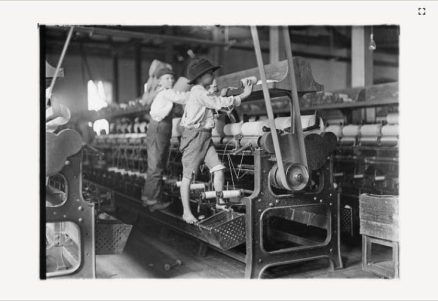
Bibb Mill No 1 Child Labor Photograph Discussion

Discussion Topic
Share to Google Classroom
Recommended Activity
Published By:
National Archives Foundation
Historical Era:
The Emergence of Modern America (1890-1930)
Thinking Skill:
Historical Analysis & Interpretation
Bloom’s Taxonomy:
Analyzing
Grade Level:
Upper Elementary, Middle School
Suggested Teaching Instructions
This activity can be used during a unit on child labor or the Progressive Era. It can serve as an introduction to the study of child labor. It also serves to teach or reinforce the process of document (photograph) analysis. For grades 6-12. Approximate time needed is 10 minutes.
Present the activity to the entire class. Students should spend a minute or two looking at the photograph unassisted. Ask them to describe the photograph and try to determine where these boys might be. Remind students to look at the whole visible area for context clues; even the smallest details may reveal the answer.
Ask students to do the following:
- Quickly scan the photo. What do you notice first?
- Who are these boys?
- Where are they?
- What are they doing?
After discussing their answers, direct students to think about what the boys might be thinking. Direct students to create a short speech or thought bubble that represents what one of the boys may be thinking.
After discussing students’ thoughts, brainstorm short speeches or thought bubbles from other perspectives on child labor. For example, what would a parent, factory owner, muckraker, consumer, or other person feel about these conditions?
This activity was adapted from “Child Labor” in the New York City Department of Education’s Passport to Social Studies, Grade 8, Unit 2, Lesson 13 (pg. 200-208).

To the extent possible under law, National Archives Foundation has waived all copyright and related or neighboring rights to “Bibb Mill No 1 Child Labor Photograph Discussion”
Description
In this activity, students will go through the process of document analysis to better understand a photograph taken by Lewis Hine, when he was an investigative photographer for the National Child Labor Committee.