

Excerpts from the Declaration of Independence

Spotlight
Share to Google Classroom

Recommended Activity
Published By:
National Archives Foundation
Historical Era:
Revolution and the New Nation (1754-1820s)
Thinking Skill:
Historical Analysis & Interpretation
Bloom’s Taxonomy:
Analyzing
Grade Level:
Middle School
Suggested Teaching Instructions
This activity may be used to introduce the language and meaning of the Declaration of Independence in a unit about the American Revolution. This activity is appropriate for students in grades 5-8. Approximated time needed is 20 minutes.
Begin the activity in a full-class setting. Ask students to focus on the highlighted parts of the document to answer the following questions:
- Who wrote this document?
- To whom is the document addressed?
- What do the creators of this document want?
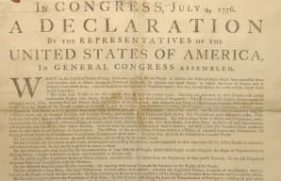
Share with students that this is the Dunlap Broadside, the first printed copy of the Declaration of Independence.
Under the supervision of the Committee of Five (including Thomas Jefferson) who drafted it, the approved Declaration was printed on July 5th. After the Second Continental Congress declared independence on July 4 in Philadelphia, Americans might not have heard the news for several days. Broadsides—large pieces of paper printed to be posted in public spaces—were a common way to spread news.
The exact number Dunlap printed is estimated to be around 200, enough to comply with Congress’s orders that the copies be distributed among the new states and troops, read aloud, and posted in public areas. Bearing only the names of John Hancock, president; and Charles Thomson, secretary; these printed copies were distributed to state assemblies, conventions, committees of safety, and commanding officers of the Continental troops.
Ask students to focus on the spotlighted parts of the letter, specifically the language used by the Founders. Ask students to consider the following guided questions.
- Who was the intended audience(s) of the Declaration of Independence? Why?
- Who was accused of crimes?
- What was the purpose of government, according to the Continental Congress?
- How is our national identity reflected in the Declaration of Independence?
- Which ideas and events seem to have influenced the Declaration of Independence?
Tell students to click “When You’re Done,” and enter their responses there.
This activity was adapted from “Declaration of Independence: Purpose of Government and National Identity” in the New York City Department of Education’s Passport to Social Studies, Grade 7, Unit 2, Lesson 12 (pg. 167-175).

To the extent possible under law, National Archives Foundation has waived all copyright and related or neighboring rights to “Excerpts from the Declaration of Independence”
Description
In this activity, students will examine excerpts from the Dunlap Broadside, the first printed and distributed copy of the Declaration of Independence.