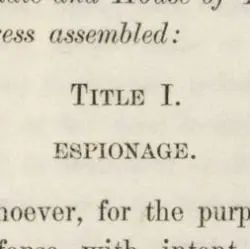
During World War I, espionage and sedition acts were adopted that resulted in over 2,000 arrests and nearly 1,000 convictions. The Espionage Act of June 15, 1917, commonly called the Sedition Act, made it illegal to make statements that would interfere with military operations, promote the success of the enemy, cause insubordination by soldiers, or obstruct the draft. It also denied the use of the mail to newspapers, periodicals, and other materials that were unpatriotic, critical, or treasonous. It gave the Post Office the power to seize any controversial periodical that went through the mail as “non-mailable.” The maximum sentence for violation of the act was 20 years in prison.
The full title is: Act of June 15, 1917, Public Law 24 (Espionage Act), An Act to Punish Acts of Interference with the Foreign Relations, the Neutrality, and the Foreign Commerce of the United States, to Punish Espionage, and Better to Enforce, the Criminal Laws of the United States, and for Other Purposes.