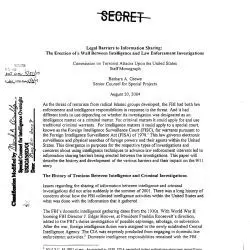
[Created by the National Commission on Terrorist Attacks Upon the United States, known as the 9/11 Commission. The National Commission on Terrorist Attacks Upon the United States (the 9/11 Commission) was established in the legislative branch as an independent bipartisan commission by section 601 of the Intelligence Authorization Act. The purposes of the Commission were to examine and report upon the facts and causes relating to the terrorist attacks of September 11, 2001, occurring at the World Trade Center in New York, New York, in Somerset County, Pennsylvania, and at the Pentagon in Virginia; to ascertain, evaluate, and report on the evidence developed by all relevant governmental agencies regarding the facts and circumstances surrounding the attacks; to build upon the investigations of other entities, and avoid unnecessary duplication, by reviewing the findings, conclusions, and recommendations of the Joint Inquiry of the Select Committee on Intelligence of the Senate and the Permanent Select Committee on Intelligence of the House of Representatives regarding the terrorist attacks of September 11, 2001, and other executive branch, congressional, or independent commission investigations into the terrorist attacks of September 11, 2001, other terrorist attacks, and terrorism generally; to make a full and complete accounting of the circumstances surrounding the attacks, and the extent of the United States’ preparedness for, and immediate response to, the attacks; and to investigate and report to the President and Congress on its findings, conclusions, and recommendations for corrective measures that could be taken to prevent acts of terrorism. The Commission investigated relevant facts and circumstances relating to the terrorist attacks of September 11, 2001, including relevant legislation, Executive orders, regulations, plans, policies, practices, and procedures; relevant facts and circumstances relating to intelligence agencies, law enforcement agencies, diplomacy, immigration, non-immigrant visas, and border control; the flow of assets to terrorist organizations; commercial aviation; the role of congressional oversight and resource allocation; and other areas of the public and private sectors. It identified, reviewed, and evaluated the lessons learned from the terrorist attacks of September 11, 2001, regarding the structure, coordination, management policies, and procedures of the Federal Government, and, where appropriate, state and local governments and nongovernmental entities, relative to detecting, preventing, and responding to such terrorist attacks. In response to the requirements under law, the Commission organized work teams to address each of the following eight topics: (1) Al Qaeda and the Organization of the 9-11 Attack; (2) Intelligence Collection, Analysis, and Management (including oversight and resource allocation); (3) International Counterterrorism Policy, including states that harbor or harbored terrorists, or offer or offered terrorists safe havens; (4) Terrorist Financing; (5) Border Security and Foreign Visitors; (6) Law Enforcement and Intelligence Collection inside the United States; (7) Commercial Aviation and Transportation Security, including an Investigation into the Circumstances of the Four Hijackings; and (8) The Immediate Response to the Attacks at the National, State, and Local levels, including issues of Continuity of Government. The Commission issued its final report on July 22, 2004. Although the Commission officially closed its doors on August 21, 2004, it continued to issue statements as a private, nonprofit group through December 2005.]